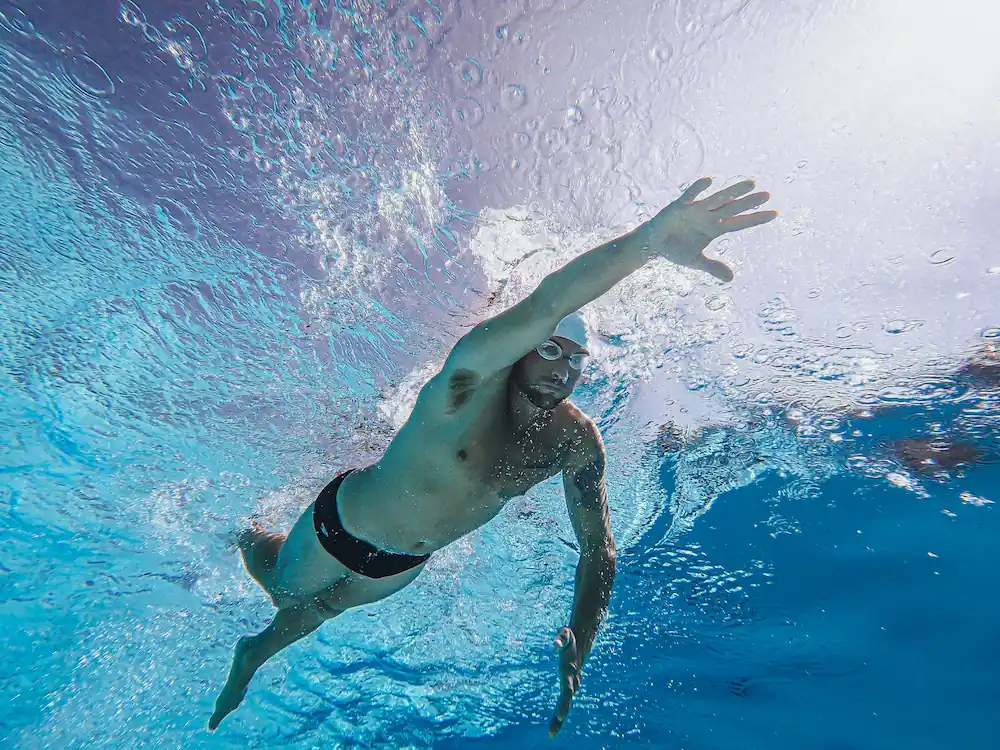
Most swimmers think of power as something the shoulders and back produce — a bigger, harder pull. But raw force is worthless if you have nothing to push against. In the water you have no floor, no wall, no fixed point; the only anchor you get is the one you build yourself, in the first quarter of every stroke, with your hand and forearm. That anchor is the catch, and understanding what it actually does underwater is the difference between swimming hard and swimming fast.
This is a technical piece. If you want the practical fixes, our companion article on the three drills that fix a stalling catch is the place to start. Here we are going one level deeper — into the biomechanics of how the underwater catch generates propulsion, and why the shape of your forearm matters more than the strength behind it.
The arms are the engine
Start with the single fact that reframes everything: in front crawl, the arms do the large majority of the propulsive work. Research into the relative contribution of the upper and lower limbs — including the frequently cited work of Deschodt and colleagues — consistently points to the arms providing most of the forward propulsion, with the legs contributing far less than swimmers tend to assume. The kick stabilises the body and adds a modest amount of drive; it does not pull you down the pool.
If most of your speed comes from your arms, and each arm stroke begins with the catch, then the catch is the highest-leverage moment in your entire stroke. Everything after it — the pull, the push, the finish — is only ever as good as the anchor it started from. A powerful pull built on a slipping catch is just a strong shove against water that is already running away from you.
What “anchoring water” actually means
The propulsive idea is simple to state and hard to do: you are trying to grip a patch of still water and pull your whole body forward past it, rather than dragging your hand backward through it. The more water you can hold still and press against, the more your body moves instead.
Two things govern how much water you can hold. The first is surface area. A flat hand alone is a small paddle. A hand plus a vertical forearm is a paddle roughly two to three times longer — and because it is presented flat to the direction of travel, it anchors far more water. The second is orientation: that paddle has to face backward, pressing water toward your feet, because by Newton’s third law only the water you push backward pushes you forward. Water pressed downward simply lifts your front end; water pushed sideways wastes itself in a sweep. Neither moves you down the pool.
This is why coaches obsess over the early vertical forearm, or high-elbow catch. The name describes a shape: the elbow stays high and near the surface while the fingertips and forearm rotate to point straight down early in the stroke, so the whole forearm becomes a vertical paddle pressing horizontally backward. Get into that shape before you apply real force, and every bit of power you then generate is aimed in the one direction that counts.
Book a session at The Venue
1-to-1 coaching in Borehamwood for club swimmers, triathletes and adult improvers. £70 an hour, or £85 for a first session built around a stroke assessment. Pick a time that suits and book online — your card is authorised, not charged, until the session is confirmed.
See available times →Not sure what your swimmer needs? Tell us about them and we will say honestly what would help.
The dropped elbow: where power leaks away
The opposite shape is the fault that costs most swimmers the most speed: the dropped elbow. Instead of bending the elbow to angle the forearm down, the swimmer initiates the pull with a straight, stiff arm, sweeping the hand down and back while the elbow trails below it. Biomechanically, two failures happen at once.
First, the effective paddle shrinks back to just the hand, because a trailing forearm slices edge-on through the water and anchors almost nothing. Second, the force is misdirected — early in a straight-arm pull the hand presses downward, lifting the body rather than driving it forward. You feel effort, your arm is clearly moving, and yet the body barely travels. That mismatch has a name swimmers know well: slipping. It is the sensation of spending energy the water refuses to convert into speed.
A subtler culprit often sets the dropped elbow up before the catch even begins: the crossover, where the lead hand crosses the centreline as it enters and extends. From a crossed-over position the arm almost has to sweep outward and downward to find purchase — which all but guarantees a dropped elbow. This is why fixing power problems often means looking further forward in the stroke than the pull itself.
Power is a system, not a shoulder
Here is the part that separates a genuinely fast catch from a merely tidy one. Once the forearm is set as a vertical paddle, the force that drives it should not come mainly from the arm. It should come from the hips and trunk, transmitted through a stable shoulder and a connected arm.
Think of the anchored forearm as a hook fixed in the water. Your body rotation — the powerful roll of the hips and torso from one side to the other — is the engine that pulls your bodyweight past that hook. The large muscles of the core and lats generate the force; the arm’s job is mostly to hold its shape and stay connected so that force reaches the water instead of leaking out through a soft, collapsing elbow. This is why strong swimmers with a poor catch plateau: they are trying to power the stroke with the small muscles of the arm alone, disconnected from the big engine behind them.
Timing is what links the two. The catch has to be set early — forearm down, elbow high — so that it is already anchored and ready at the exact moment your body rotation arrives to drive against it. Set it too late and you rotate before you have anything to push on; the power arrives and finds nothing there. A well-timed catch and a well-timed rotation are the same act of propulsion seen from two ends.
How to know it is working: distance per stroke
The catch is invisible from the surface, but its effect is measurable, and the cleanest measure is distance per stroke — read through your stroke count per length. A catch that truly anchors water moves you further with every pull, so at a fixed, comfortable pace your stroke count should gradually fall as the catch improves. Fewer strokes to cover the same length, at the same effort, means each stroke is holding more water. It is a far more honest gauge of technical progress than how hard a set happened to feel.
Track it deliberately. Pick a steady pace, count strokes across a few lengths, note the number, and re-test every few weeks. If the count is drifting down while your pace holds, your catch is converting more of your effort into propulsion. That is power, correctly defined — not force applied, but force transmitted.
For triathletes this pays twice: a catch that holds water costs less energy over a 1.5km or 3.8km swim and leaves more for the bike, which is why it sits at the centre of our triathlon swim coaching.
Why you cannot fix this by feel alone
The hard truth about the catch is that what you think your forearm is doing underwater and what it is actually doing are usually very different. The dropped elbow feels, from the inside, like a perfectly good pull. This is the one element of technique where seeing it changes everything, which is why we pair catch work with underwater swim video analysis — filming from below the surface, where the catch actually happens, so you can watch your own forearm anchor or slip and correct it against real footage rather than guesswork.
If you want your catch assessed and rebuilt around the biomechanics above — the high-elbow shape, the body connection, and the timing that links them — our freestyle stroke clinics and 1-to-1 coaching across Hertfordshire and North London are built to find the fault that is costing you the most speed, and turn effort you are already spending into speed you can actually see on the clock.