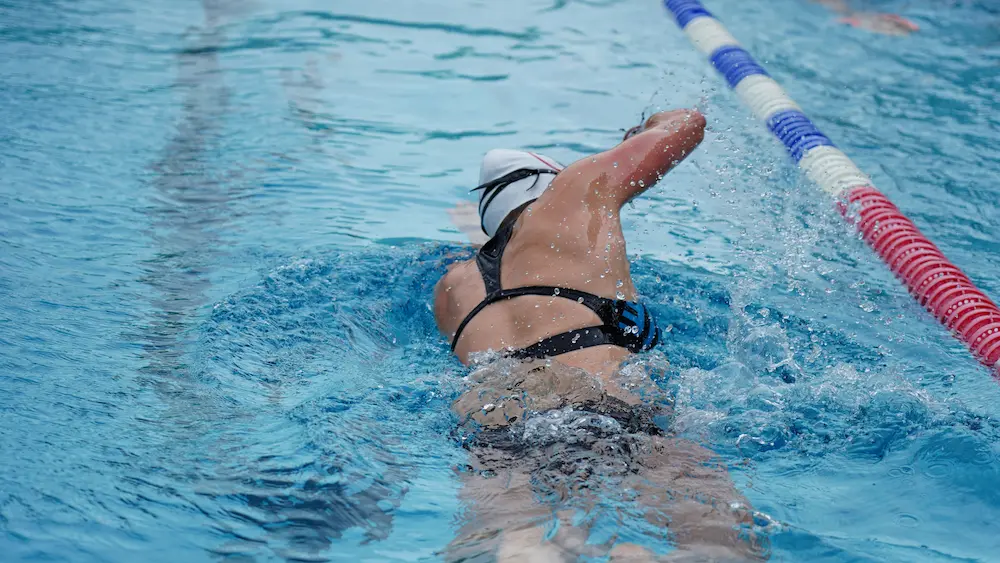
You have added the sessions. You have done the threshold sets and the kick work. And yet the clock has barely moved. For a lot of swimmers who have stopped improving, the problem is not the engine — it is what the hand and forearm do in the first quarter of the stroke. If your catch slips, every length leaks speed no amount of fitness will recover. It is one of the most common reasons a strong, fit swimmer stays stubbornly slow.
Here is what the catch actually is, why it tends to fail, and three drills that build a catch that holds water.
What the catch is — and why it matters so much
The catch is the front part of the freestyle pull: the moment your hand enters, extends, and then sets the hand and forearm against the water so you can pull your body past that anchored point. Get it right and the forearm becomes a large, fixed paddle. Get it wrong and the arm slides through the water like a spoon through air.
It helps to picture the freestyle arm in phases — entry, extension, catch, pull and finish — and to recognise that everything downstream depends on the catch. A powerful pull built on a poor catch is just a strong shove against water that is already slipping away from you.
It matters because, in front crawl, the arms do the large majority of the propulsive work. Research into the relative contribution of arms and legs in sprint front crawl — including the often-cited study by Deschodt and colleagues — points to the arms providing most of the forward propulsion, with the legs contributing far less than many swimmers assume.
The practical takeaway is blunt: if the arms are where most of your propulsion comes from, then the catch is the highest-leverage thing in your whole stroke. A small improvement there outweighs a large improvement almost anywhere else.
Why your catch stalls: the dropped elbow
The single most common fault is the dropped elbow. Instead of bending the elbow to point the forearm down while keeping the elbow high and forward, the swimmer pulls back with a straight, stiff arm. The hand sweeps down and the elbow drops, so the press is aimed towards the bottom of the pool rather than straight back behind you.
This causes two problems at once. First, water you press downwards lifts you up — it does almost nothing to move you forwards. Second, a straight-arm pull presents only the hand, not the much larger surface of the hand-plus-forearm, so you anchor far less water. The result is the sensation good coaches describe as “slipping”: the arm moves, the effort is real, but the body does not travel.
The opposite — and the goal — is sometimes called the early vertical forearm, or high-elbow catch: the elbow stays high near the surface while the fingertips and forearm angle down early, so you are pressing the whole forearm straight back from the very start of the pull.
A second, sneakier fault sets the dropped elbow up before the catch even begins: the crossover, where the lead hand crosses the centreline of your body as it enters and extends. From a crossed-over position the arm almost has to sweep out and down to find the water, which all but guarantees a dropped elbow. Fixing the catch often starts further forward, by fixing where the hand enters — roughly shoulder-width, not pointed at your nose.
Book a session at The Venue
1-to-1 coaching in Borehamwood for club swimmers, triathletes and adult improvers. £70 an hour, or £85 for a first session built around a stroke assessment. Pick a time that suits and book online — your card is authorised, not charged, until the session is confirmed.
See available times →Not sure what your swimmer needs? Tell us about them and we will say honestly what would help.
Drill 1: Front scull
Sculling teaches feel — the proprioception that lets you sense pressure on your hand and forearm. Float face-down, arms extended in front with the elbows slightly higher than the hands, and make small, controlled in-and-out movements with the forearms, angling the hands to keep light pressure on the water the whole time. Use a snorkel or breathe by gently lifting when needed. You are not trying to travel; you are learning what “holding water” feels like so you can find it mid-stroke.
Drill 2: Fist swimming
Swim normal freestyle, but with your hands closed in loose fists. With the paddle of the hand removed, the only way to feel any purchase on the water is to engage the forearm — exactly the surface a dropped elbow wastes. Swim a length or two with fists, then open the hands and swim normally. A good catch suddenly feels enormous, because you have switched your attention from the hand to the whole forearm. Alternate fist and open-hand lengths so the feeling transfers into full-speed swimming.
Drill 3: High-elbow dog-paddle
Dog-paddle, done deliberately, isolates the catch at a speed slow enough to think. Swim with a short underwater arm action and no over-water recovery, consciously keeping the elbow high while the forearm presses back and down, then forward again. Because everything happens slowly and in front of you, you can watch and correct the exact part of the stroke that matters. Build from dog-paddle into full freestyle over a set so the high-elbow shape survives when the recovery and rotation return.
How the catch shows up in your numbers
The catch is invisible, but its effect is measurable. The clearest feedback is your stroke count — how many strokes it takes to cover a length. A catch that holds water moves you further with each pull, so as it improves you should be able to cover the same length in fewer strokes at the same effort. Your distance per stroke goes up.
Track it. Pick a steady, comfortable pace, count your strokes per length across a few lengths, note the number, and re-test every few weeks. If the count is gradually falling while your pace holds or improves, the catch is doing its job. It is a far more honest measure of technical progress than how hard a set happened to feel. If you race triathlon, the same test applies to your swim leg: fewer strokes at the same effort means more left for the bike, and it is the first thing a triathlon swim coach will check.
Make the change stick
Drills do not fix anything on their own — they are a way of rehearsing a movement slowly enough to learn it. The change only counts when it survives at race pace. So sandwich your drilling: a few lengths of a drill, then immediately a length of normal swimming holding the same feel, repeated. Count your strokes per length as you go; a better catch usually shows up as covering the same distance in fewer, more powerful strokes.
The catch is also genuinely hard to feel and even harder to self-diagnose, because what you think your arm is doing underwater and what it is actually doing are often very different. This is the one element of technique where seeing it on film changes everything, which is why we pair catch work with swim video analysis — above and below the surface — so you can see the dropped elbow for yourself and watch it improve.
If you want this assessed and rebuilt properly, our freestyle stroke clinics in Hertfordshire and North London are built around exactly this: finding the technical fault that is costing you the most speed, and drilling it until it holds.