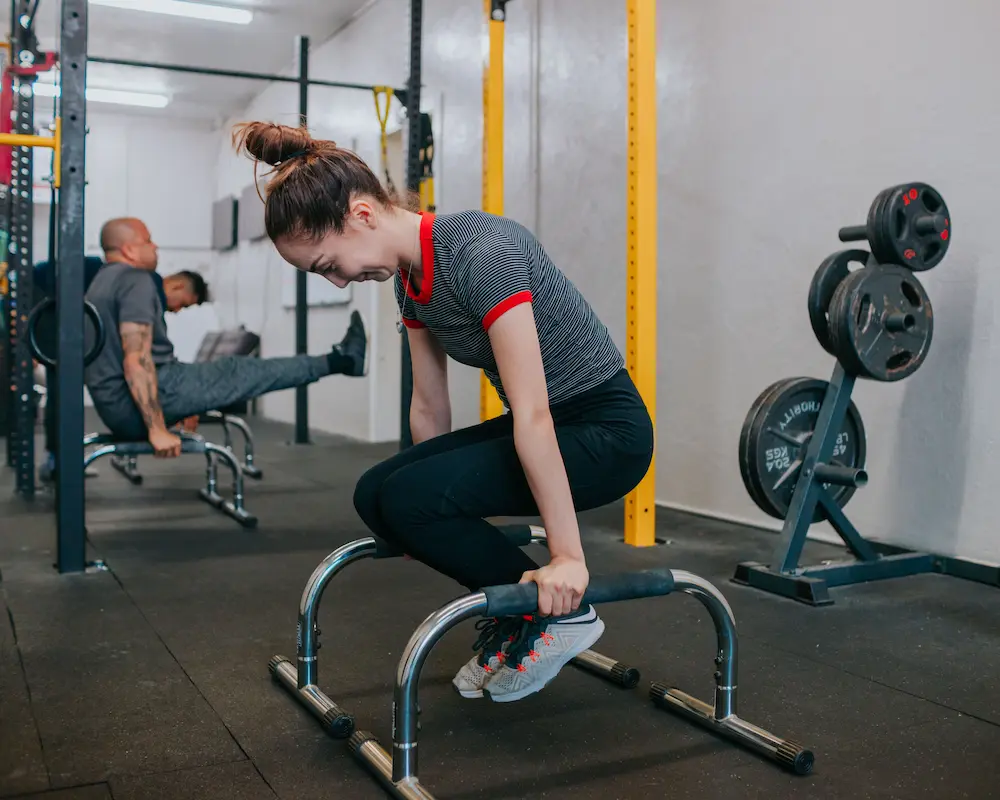
Every September, the same conversation starts on poolside. A swimmer moves up a squad, the programme adds a land session before or after the water, and a parent asks me some version of the same question: “Is this actually going to make them faster — and is it safe at their age?”
Both halves of that question deserve a proper answer, because dryland is the part of a swimming programme most likely to be done badly. Done well, it is one of the highest-return hours in the week. Done badly, it is thirty minutes of press-ups in a corridor that tires a swimmer out before they get in the water and improves nothing.
Here is what the evidence actually says, what it should look like at each age, and where the real mistakes are.
Does dryland actually make swimmers faster?
Short answer: yes, but less dramatically than the gym content on your child’s phone suggests, and only if it is the right kind.
The most useful study for a swim parent is a randomised controlled trial that took adolescent swimmers already training around seven hours a week in the water and added 90 minutes a week of dryland strength work. Over eight weeks, freestyle performance improved by roughly 2.1 per cent and backstroke by around 0.5 per cent — on top of the improvement the swimmers were already getting from swimming alone.
Two per cent sounds small until you convert it. On a 1:10 100m freestyle, two per cent is about 1.4 seconds. At county level, 1.4 seconds is frequently the difference between a qualifying time and a near miss, and it is a bigger single jump than most swimmers get from a whole season of extra water volume once they are past the beginner stage.
Note the asymmetry, though. Freestyle improved four times more than backstroke. That is a useful warning against treating dryland as a magic multiplier applied evenly across everything. It transfers where the strength demand matches the stroke — which is why our guides are split by stroke rather than issued as one generic programme.
Book a session at The Venue
1-to-1 coaching in Borehamwood for club swimmers, triathletes and adult improvers. £70 an hour, or £85 for a first session built around a stroke assessment. Pick a time that suits and book online — your card is authorised, not charged, until the session is confirmed.
See available times →Not sure what your swimmer needs? Tell us about them and we will say honestly what would help.
The age question, answered properly
This is where most of the anxiety sits, so let me be direct: the idea that strength training stunts growth or damages growth plates is a myth, and it has been contradicted repeatedly by the research for over two decades.
The National Strength and Conditioning Association’s position statement on youth resistance training is unambiguous — appropriately designed and supervised resistance training is safe and beneficial for children and adolescents. Faigenbaum, Lloyd and colleagues went further in the British Journal of Sports Medicine, arguing that the greater risk to young athletes is not strength training: it is arriving at adolescence with insufficient physical literacy to handle their sport’s demands.
The genuine injury risk in youth strength work comes from three things, none of which is the age of the child: unsupervised sessions, poor technique, and load added before technique is stable. Every one of those is a coaching failure, not a biological one.
What does change with age is what the session should contain. The Youth Physical Development model is the framework worth knowing, and it maps neatly onto how we structure our own guides:
- Roughly 10 to 14 — bodyweight only. Movement quality, co-ordination, jumping and landing, core control, basic gymnastic shapes. The aim is a swimmer who can control their own body before they control an external load. Nothing here needs a gym.
- Roughly 14 to 16 — bodyweight retained, with a careful introduction to light external load. This is the window where technique is taught properly, because it is the last easy chance to do so.
- 16 and over — progressive loaded strength, built on the technique base from the previous band. This is where the meaningful power development happens.
Note that these are bands, not birthdays. A physically mature 14-year-old and a late-developing 16-year-old should not be on the same programme, and any coach who assigns by school year rather than by maturity and competence is guessing.
Where dryland goes wrong
Four mistakes account for nearly everything I see.
It is used as conditioning rather than strength. Thirty minutes of continuous circuits with minimal rest is a cardiovascular session. Swimmers already get plenty of that in the water, and they get it in a medium that does not beat up their joints. Strength work needs real rest between sets — if a swimmer is gasping throughout, it has become a fitness session wearing a strength costume.
It is scheduled to sabotage the water. A hard leg session immediately before a technical kick set produces a poor technical kick set. Land work should sit after the key water session of the day, or on its own, not in front of the session it will degrade.
It ignores the shoulder. Swimmers accumulate enormous internal rotation volume and very little of anything else. Dryland is the best opportunity in the week to balance that — posterior chain, external rotation, scapular control, thoracic mobility. A programme that adds more pressing to a swimmer’s shoulder is making the problem worse, not better.
It is generic. A sprint 50 freestyler and a 1500m swimmer need different things. So do a breaststroker and a butterflier. Stroke and event should shape the programme, not just the fact that the athlete swims.
Where to start
We publish eleven free 12-week dryland guides in the training guides library, split into three tiers so you can pick the right one rather than the nearest one:
- Youth — land training for 10 to 14s, 14 to 16s, and progressive strength for 16 and over. Age-appropriate, supervised, written to be read by a parent or coach.
- Club — club swimmer dryland strength, sprint swimmer power and distance swimmer strength for senior and adult performance swimmers carrying higher load and volume.
- Masters — a per-stroke set for adult swimmers, joint-aware throughout: freestyle, backstroke, breaststroke, butterfly, and an all-strokes guide.
They are gym and dryland plans — sets, reps and focus — not swim sets. Free, no catch.
The honest summary
Dryland is worth doing. Around 90 minutes a week, properly structured, is a realistic couple of per cent on a freestyle time — which at county level is not a rounding error. It is safe at every age that a club swimmer is likely to be training, provided it is supervised and technique comes before load.
But it is a supplement, not a substitute. No amount of land work fixes a catch that is slipping water, and the swimmer who spends the autumn adding squats while ignoring their stroke will be faster on land and no faster in the pool. If you are not sure which of the two is your swimmer’s limiter, that is exactly what video analysis is for — and it is usually the cheaper question to answer first.
Pick the guide that matches the swimmer in front of you, start light, and let technique lead.