Qualifying for the county championships feels like the finish line. It is the start of a different job, and the six weeks before the meet decide whether your swimmer turns up to race or to take part.
This guide picks up where qualifying ends. If you are still chasing the time, start with how to qualify for county championships and county qualifying times explained, or check where your swimmer stands with the county times checker. If you are here because the time is in the bag, read on.
What changes once you have qualified
Before qualifying, every gala is an attempt at a number. After it, one meet matters, and the question becomes “can they swim their best on that day?”
- The target moves. The qualifying time was the entry ticket. The new target is a personal best in a heat, and for some swimmers a place in a final.
- Racing gets more selective. Galas in the last few weeks become rehearsals, not attempts. Racing tired at a small meet to chase a few hundredths can cost more than it gains.
- Small things now count. A clean start, good walls and a sensible pace plan can be worth more than another month of training.
The club coach runs the plan. Your job, and any extra coaching around it, is to support that plan and never compete with it.
The 6-week plan
Treat the weeks below as a shape, not a prescription, and fit it around what the club is already doing.
Weeks 6 to 4: build and fix one thing
This is the last stretch of real training, and the window for any technical change. Pick one priority, agree it with the club coach, and drill it until it holds at race pace. A new change brought in during the last fortnight is a change the swimmer will not trust on the blocks.
If the time is being lost at the wall, this is when to book a starts, dives and turns clinic. If it is a stroke fault that only appears when the swimmer is tired, a 1-to-1 session can find it and give them a drill to take back to squad.
Weeks 3 to 2: sharpen
The work gets faster and more specific. Expect more race-pace swimming, more practice starts and turns, and fewer long, grinding sets. This is also when the race plan for each event should be settled, so every fast swim in training is a rehearsal of it.
Keep sleep and food steady. A swimmer short of sleep now will feel it on the day.
The final 10 to 14 days: the taper
Training volume comes down so the body can absorb the work already done. Three principles hold almost everywhere:
- Cut volume, keep speed. The distance comes down, but short, fast, race-pace swims stay in so the swimmer does not lose their feel for speed.
- Keep the routine. Same session times where possible, same warm-up habits, same bedtime. Taper is not a holiday.
- Trust the coach’s timing. Taper length depends on age, training load and event. A younger swimmer on a light programme needs very little; an older distance swimmer may need longer.
Feeling sluggish partway through a taper is common and usually passes. Do not add training to “top up” the fitness. (For adult swimmers, the taper looks different; see getting masters meet-ready.)
Book a session at The Venue
1-to-1 coaching in Borehamwood for club swimmers, triathletes and adult improvers. £70 an hour, or £85 for a first session built around a stroke assessment. Pick a time that suits and book online — your card is authorised, not charged, until the session is confirmed.
See available times →Not sure what your swimmer needs? Tell us about them and we will say honestly what would help.
Race plans: decide before the day
Every event needs a plan the swimmer can say in one sentence. For example, in a 100: “Strong first 15 metres, controlled first 50, build on the third length, attack the last 25.” In a 200, the plan is mostly about not spending too much in the first 50, which is the most common mistake at county level.
A good race plan covers three things:
- Pacing. Roughly even splits, with a controlled start. Going out much faster than planned usually costs more at the end than it gains at the start.
- Breathing, where it matters: into and out of each wall, and into the touch.
- One cue. One technical thought per race, not five. “Long underwaters” or “fast feet on the turn” is enough.
Write the plans down and keep them in the kit bag to read before marshalling.
Starts, turns and underwater work
In a 25m pool, a 100 has a start, three turns and a finish: a lot of race that is not the stroke, and the part club swimmers practise least.
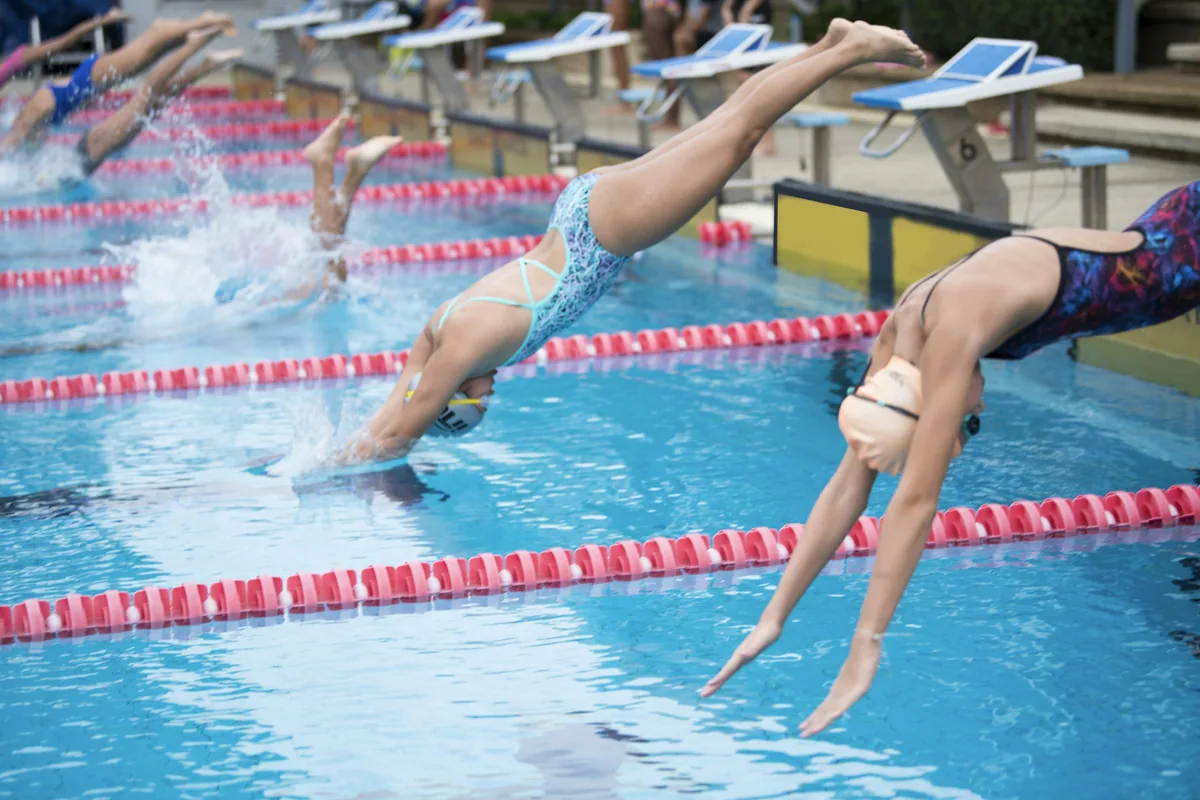
- Starts. A consistent set-up, a reaction they trust, and a clean, streamlined entry. Practise from the same start position every time, so it is automatic under pressure.
- Turns. Hold speed into the wall without gliding or a short extra stroke, rotate quickly and push off fast.
- Underwater kicking. Swimmers are allowed up to 15 metres off each wall. Most age-group swimmers use far less and break out into a stroke slower than their push-off. A few extra metres of strong underwater kick on each wall adds up across a race.
These skills improve fastest with focused work (more on that in why has my child stopped dropping time).
The night before
- Pack the bag the evening before: two costumes, two pairs of goggles, two hats, towels, warm kit for poolside, the race plans, a water bottle and snacks.
- Read the meet information: warm-up time, session times, how the heats are run and when finals swimmers need to report. Check the venue and plan the journey with time to spare.
- Keep the evening ordinary. A normal dinner and a normal bedtime. One restless night rarely spoils a race.
Race day: warm-up, food and logistics
Warm-up. Championship warm-ups are busy, with crowded lanes and limited time. The swimmer should have a simple, flexible routine: easy swimming, some drills, a few pace efforts, and a start or two if the warm-up allows them. Keep moving and keep warm between warm-up and the first race; poolside can be cold and swimmers sit for a long time.
Food. Breakfast two to three hours before warm-up, something they eat at home. Between swims, small plain snacks and water. Nothing new on race day.
Events and heats. Know the event numbers, roughly when each one will be swum, and where and when to marshal. Many county meets run heats in one session and finals later, while others run heat declared winners, where the heat result is the final result. The meet programme says which. If there are finals, plan rest, food and travel for the gap, and confirm how finals swimmers report.
After each race. A quick word with the club coach, warm down if there is space, refuel, reset.
Managing nerves
Nerves are normal and, in a sensible amount, useful. The aim is to stop them taking over.
- Focus on the process. “Strong first 15 metres, good walls” is something a swimmer can do. “I have to get a PB” is not something they control.
- Have a routine. The same warm-up, snack and steps behind the blocks. Familiar is calming.
- Breathe out slowly. A few long, slow breaths out behind the blocks lower the heart rate and steady the hands.
- Keep parents’ words short. “Enjoy it, we’re proud of you” works better than a technical briefing from the balcony. Leave the coaching to the coaches.
Make the six weeks count
The six weeks before the county championships turn a qualifying time into a race your swimmer is proud of, and the gains are usually at the wall, in the pacing and in the head.
If your swimmer has qualified and you want one focused piece of work before the meet, our competitive swimming coaching is built to sit alongside the club programme, not replace it. Book a 1-to-1 session at The Venue to work on the stroke, the start or the turns, or join a starts, dives and turns clinic and sharpen the walls before race day.
Parent FAQs
Should my child train extra sessions before the county championships?
Not usually. The club programme is already built around the meet, and adding volume in the last six weeks tends to arrive as fatigue on race day. If you want to add anything, add quality: a focused session on starts, turns or a single stroke fault, agreed with the club coach.
How long should a taper be for a junior swimmer?
There is no single answer, and it is the club coach’s call. Younger swimmers on modest training loads need very little taper; older swimmers on bigger loads need more. What matters is that volume comes down while some fast, race-pace swimming stays in, so the swimmer arrives rested but sharp.
What should my child eat on the day of the county championships?
Familiar food, eaten early enough to settle: a normal breakfast two to three hours before warm-up, then small, plain snacks and water between swims. Race day is not the day to try anything new.