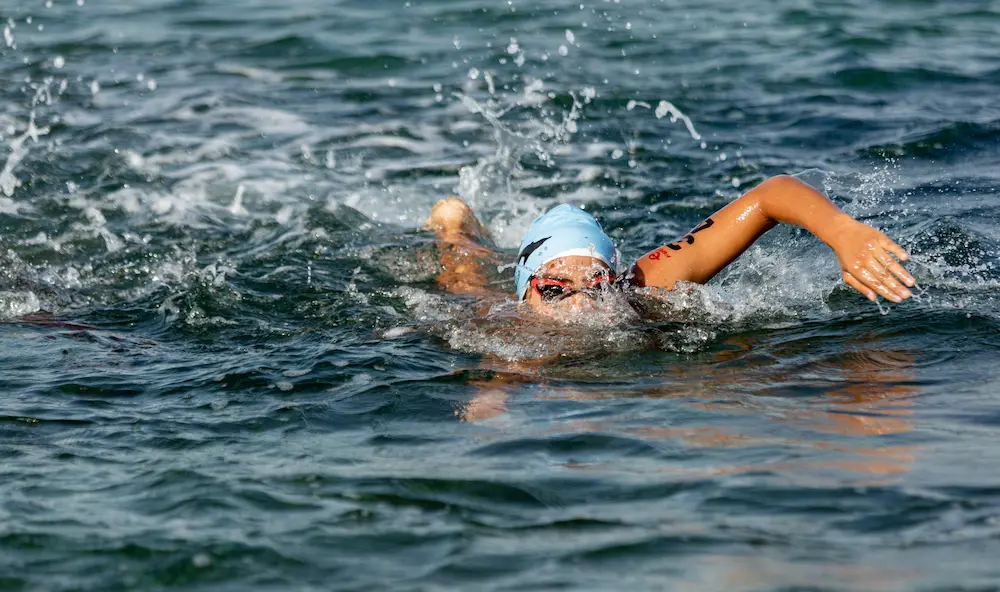
In a pool, navigation is free. The black line does the thinking, the wall arrives on schedule, and you can pour every watt into swimming. Open water gives you none of that. The single biggest time loss on the swim leg for most age-group triathletes is not fitness — it is swimming further than the course actually is, because they drifted off-line and never noticed.
Sighting is the skill that fixes it. Done well, it costs you almost nothing. Done badly, it lifts your head, sinks your hips, stalls your rhythm and leaves you arriving at T1 already behind. The good news is that sighting is almost pure skill rather than fitness, which means it responds quickly to a little focused practice. This is how to sight without losing speed.
Why a straight line is worth more than fitness
There are no lane ropes in a lake. Wind, current, sun glare and the simple fact that most people pull slightly unevenly all push you off course. A heading error of just a few degrees does not feel like much for the first fifty metres — but over a 1,500m Olympic swim, and certainly over a 3.8km Ironman, those small errors compound into real, wasted distance.
The maths is unforgiving in a way that flatters good navigators. If you swim even a little crooked, you are paying for those extra metres at race effort, with your most oxygen-hungry muscles, at the worst possible moment. Two athletes with identical swim fitness can exit the water a minute apart purely on how straight they swam. Fitness is expensive to buy and slow to build; a straighter line is a skill you can practise this week. And drift usually gets worse, not better, as you tire and your stroke loses its symmetry late in the swim — exactly when you can least afford the extra distance.
The crocodile-eyes technique
The classic fault is treating a sight like a breath taken to the front — head up, chest up, legs dragging down behind you like an anchor. Lifting the head pushes the hips and legs deeper, which increases drag and kills the glide you have worked so hard to build. The fix is to sight low and sight briefly.
Think “crocodile eyes”: lift your eyes just high enough to clear the surface — goggles out, mouth still in or near the water — take a quick photo of what is ahead, then drop straight back down. Crucially, separate the two jobs: sight forward first, then rotate to the side to breathe as your face returns to the water. Trying to sight and breathe in one head-up movement is what causes the big, rhythm-wrecking lift.
Time the sight to the front of your stroke. As your lead hand extends and presses into the catch, that extension gives you a moment of support to raise the eyes without the whole upper body rising. Keep it to a fraction of a second. You are not reading the horizon — you are confirming a direction.
Book a session at The Venue
1-to-1 coaching in Borehamwood for club swimmers, triathletes and adult improvers. £70 an hour, or £85 for a first session built around a stroke assessment. Pick a time that suits and book online — your card is authorised, not charged, until the session is confirmed.
See available times →Not sure what your swimmer needs? Tell us about them and we will say honestly what would help.
How often should you actually sight?
There is no single right answer; the honest one is “as often as you need to stay straight, and no more.” In flat, calm water with a clear target you might sight only every eight to ten strokes. In chop, glare or a crowded pack, every four to six strokes keeps you honest. The cost of an unnecessary sight is small; the cost of swimming fifty metres in the wrong direction is enormous.
Pick the biggest, most reliable landmark you can — a large fixed object on the shore behind the buoy is often easier to hold than the buoy itself, which can disappear behind swell or other swimmers. Marker buoys move slightly and sit low; a building, a tree line or a hill behind the turn gives you a stable bearing between sights.
When you cannot see the buoy
Sometimes the target simply is not there: low sun straight ahead, a buoy hidden behind swell, or a wall of splashing arms in a packed first 200m. Have a plan for those moments rather than stopping and treading water.
Time your sight to the highest point of your stroke and, in chop, to the top of a wave — lifting the eyes at the instant you are highest gives the clearest view for the least effort. If the sun is the problem, race in a darker or mirrored lens and navigate off anything you can see: the shoreline to one side, a line of moored boats, the broad direction of the pack. And use stroke counting — if you know a buoy is roughly forty strokes away, you can put your head down and swim most of that blind, sighting only to confirm as you close in.
Let the pack do some of the navigating
Sighting and drafting are the same conversation. Unlike the bike leg, drafting in the swim is permitted under World Triathlon competition rules, and it is one of the most energy-efficient things you can do in a race. Sitting just behind another swimmer’s feet, or level with their hip, can save effort and reduce how often you personally need to sight — you let them do some of the work of holding the line. Aim for the cleanest water you can find: directly on a swimmer’s toes, or tucked beside their hip where the wake helps carry you. Just be ready for contact — the start of a triathlon swim is a contact sport, and staying relaxed when there are arms and feet around you is itself a skill worth training.
The catch is that you must verify, not blindly trust. Plenty of athletes have followed a confident-looking swimmer straight off course. Use the draft to save energy, but keep your own sights frequent enough to confirm the group is actually heading for the buoy. If you are a strong, nervous-in-open-water pool swimmer, learning to hold a draft calmly is often the single biggest confidence unlock — and it is a core part of our open water swim coaching.
Three ways to practise before race day
1. Sighting reps in the pool. You do not need a lake to build the movement. Every few lengths, lift your eyes to a fixed target at the end of the pool — a clock, a sign — using the crocodile-eyes action, then breathe to the side as normal. Do enough that sighting stops feeling like an interruption and becomes part of the stroke.
2. Buoy turns. Most time is lost, and most contact happens, at the turns. Practise rounding a fixed point: sight early into the turn, shorten your stroke, and accelerate out of it rather than drifting wide. A controlled turn can gain several seconds and a lot of clear water.
3. Course reconnaissance. Before the gun, look at the course from the bank. Note where the sun will be, which buoys are turn buoys, and what large landmarks sit behind each one. Two minutes of planning on dry land saves far more than two minutes in the water.
Sighting is a small skill with an outsized return: it is free speed that does not cost you a single extra session of fitness. If you want it assessed and drilled properly — in the pool, before you take it outside — that is exactly what our triathlon swim coaching in Hertfordshire and North London is built to do.