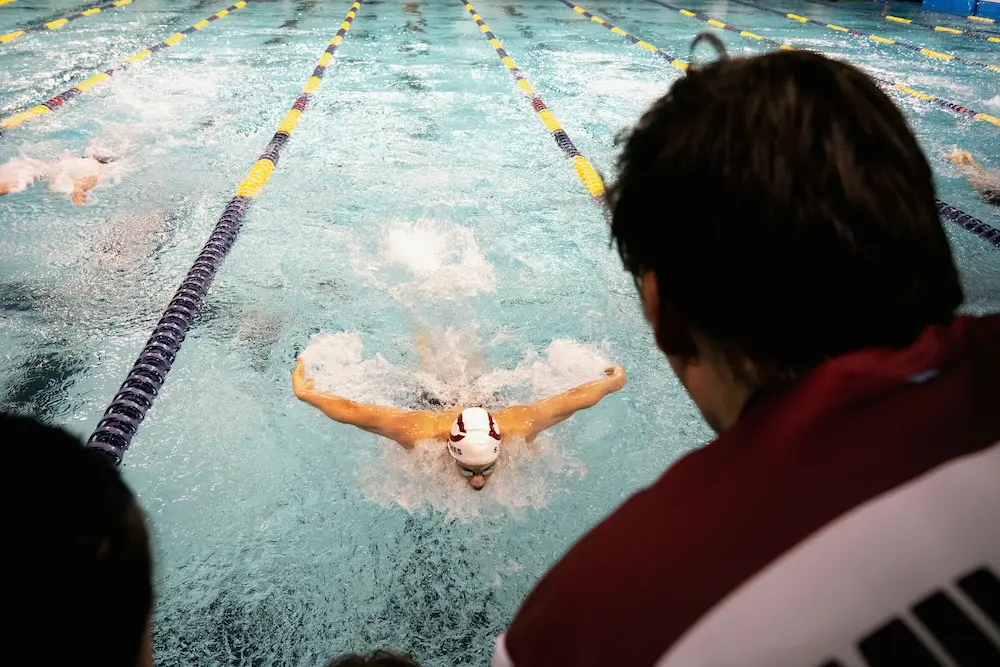
Butterfly is the stroke that makes parents wince at a gala. It looks brutal — the splash, the heaving shoulders, the swimmer who blows up halfway down the pool and finishes gasping. Yet for a lot of club kids, fly becomes their favourite once the basics click, because done well it is less about brute strength and more about rhythm. The job for you as a parent is not to coach it. It is to understand what good butterfly actually looks like, what is realistic at different ages, and how to back the skill between sessions rather than pile on pressure about times.
Here is a parent-friendly guide you can read, and share around your club.
Why butterfly is worth the struggle
Butterfly builds core strength, body control and a sense of rhythm that feeds straight back into the other three strokes — and into individual medley. A swimmer who learns to undulate and time the stroke properly is building a body that moves better in the water generally, not just one party trick.
Learning it well early also heads off a stubborn problem: muscling through. When a child forces butterfly with arms and shoulders before they have the timing, they lock in habits that make every race feel exhausting and cap how far they can go. For county-level and aspiring county swimmers, fly is a fixed part of the 100 IM, 200 IM and medley relays, so the skill you protect now quietly pays off later, when the distances and the sessions step up.
What good butterfly actually looks like
Coaches talk about undulation, timing and rhythm. For a parent in the spectator seats, it helps to watch for three simple things.
Body shape. A good fly swimmer is led by the crown of the head, with shoulders and hips staying close to the surface — a smooth wave travelling through the body, not a dolphin-show porpoise diving up and out of the water. The give-away of a problem is a sharp bend at the waist or knees instead of one long ripple.
Arms. Both arms move together: they enter slightly wider than the shoulders, press back under the body, then swing forward low and relaxed over the surface. The hands should exit near the hips and travel forward close to the water — not lift high and straight up like a weightlifting move.
Kick and timing. The legs stay together like a mermaid tail, with loose ankles and the kick driving from the hips, not snapping from the knees. In a well-timed stroke there are two kicks for every arm cycle — one as the hands enter and sweep out, one as the arms recover and the swimmer breathes.
If your child looks like they are fighting the water — big splashes, head held high, knees pumping — it almost always means the stroke has tipped over into strength and lost its smoothness. That is information, not failure.
Book a session at The Venue
1-to-1 coaching in Borehamwood for club swimmers, triathletes and adult improvers. £70 an hour, or £85 for a first session built around a stroke assessment. Pick a time that suits and book online — your card is authorised, not charged, until the session is confirmed.
See available times →Not sure what your swimmer needs? Tell us about them and we will say honestly what would help.
The faults parents worry about (most are normal)
When fly looks messy, or your child “dies” after 25 metres, it is tempting to assume something is wrong. Usually it is just a developing swimmer meeting a hard stroke, and the faults are predictable and fixable.
The most common is breathing too late and for too long — finishing the pull, then lifting the head and hanging there for an extra beat, which drops the hips and kills all momentum. Close behind is kicking from the knees, typical in younger swimmers with a still-developing core, where the legs whip up and down instead of the wave starting at the chest and flowing through the hips. And then there is racing before there is rhythm: children try to sprint butterfly before they can hold a relaxed, repeatable stroke, so they blow up at the halfway flags.
Good programmes meet all three the same way — by keeping the distances short. Expect to see plenty of work over 12.5 to 25 metres, lots of drills and single-arm swimming, and volume that only creeps up as control improves. Butterfly should be a skill to learn, not a fitness punishment to survive.
The drills, and what they are quietly teaching
You will see your child doing odd-looking things in the fly sets. Knowing what each one is for helps you give the right encouragement, and stops “why are you just kicking on your back?” landing as criticism.
| Drill | What it looks like | What it builds |
|---|---|---|
| Streamline dolphin kick | Arms locked above the head, dolphin-kicking on front or back | The body wave and a strong kick, with no arms to think about |
| Mermaid / arms-by-side kick | Arms by the sides, face in, dolphin kick on the surface | The feel of undulation; stops the knees taking over |
| Single-arm butterfly | One arm doing the full stroke, the other extended or resting | Timing, breathing and body line, one side at a time |
| Three kicks, one pull | Several dolphin kicks, then one full arm stroke and breath | Slows everything down so timing feels controlled |
| Fly with fins or a snorkel | Short fins or a snorkel during butterfly | Extra support, so they can hold the right rhythm for longer |
The thread running through all of them is the same: shape and timing before speed. That is exactly the right priority for a developing swimmer, even when it looks slow.
How to help without coaching from the balcony
Parents shape whether butterfly becomes something a child enjoys or dreads — and often the most useful thing you can do is to say very little about the technique itself, and trust the coach to coach.
Keep your language process-based. After a rep or a race, “did that feel smooth?” or “did the timing feel easier today?” does far more than “what was your time?” Praise the habits you can see — sticking with the stroke to the wall, a nice low relaxed recovery — rather than only the placing. Normalise that butterfly is genuinely hard and takes years: even national-level swimmers have days when fly feels like wading through treacle, and a cleaner kick or a better entry is a real win even in a week when the clock does not move.
And back the coach on building slowly. If your child is kept on 25s and 50s rather than moved up to 100 fly, that is almost always protecting technique, not limiting ambition. Strong skills now mean more event choices later. If you want a second pair of eyes on where your child’s stroke is actually leaking time, that is the entire point of swim video analysis — seeing the dropped timing or the knee-driven kick on screen makes it click in a way that no amount of poolside shouting can.
Training fly and racing fly are different animals
It helps children to understand that butterfly in a set and butterfly in a race are not the same task. In training the currency is quality and repeatability — short reps with good mechanics, broken up with easier strokes, often swum deliberately “controlled” rather than flat out. In a race, the goal is to hold those same good mechanics while gradually lifting the effort, not to abandon the technique the moment it counts.
The message that sticks with young swimmers is race how you train. Practise rushed, head-up fly and that is exactly what shows up under pressure on race day. Practise smooth, rhythmic fly and that is what holds when the adrenaline hits.
When should my child start butterfly?
Most UK club pathways introduce basic butterfly once a child is comfortable with front crawl, backstroke and the basics of breaststroke. The early work is dolphin kick in streamline on front and back, plus a simple arm action over short distances with lots of drill support. As they move through teaching and skills squads, coaches layer in better timing, a more consistent breathing pattern, and a gradual build from 15 metres towards 25 and beyond.
If your child has not started fly yet, it is usually a good sign — a thoughtful coach waiting for a little more strength and coordination, not an oversight. The same patience runs through structured pathways like the county development camps run across Hertfordshire, where butterfly skill is built up in stages rather than rushed.
The short version for club parents
Butterfly is a long-term project that rewards patience and skill before distance. Watch for a smooth body wave, relaxed but controlled arms and a two-beat dolphin rhythm — not splashing and fighting the water. Support it by praising effort and process, backing the coach’s decision to build gradually, and reminding your child that some sessions and races will simply feel heavy, and that is normal.
If you would like your child’s butterfly properly assessed and rebuilt, our butterfly stroke clinics and coaching for junior swimmers across Hertfordshire and North London are built around exactly that: finding the fault that is costing the most, and drilling it patiently until it holds.